

Climate risks are bigger than we thought — but so is the potential toolbox.
Outlier Projects is a climate philanthropy that accelerates research to stabilize Earth systems.

The Risks
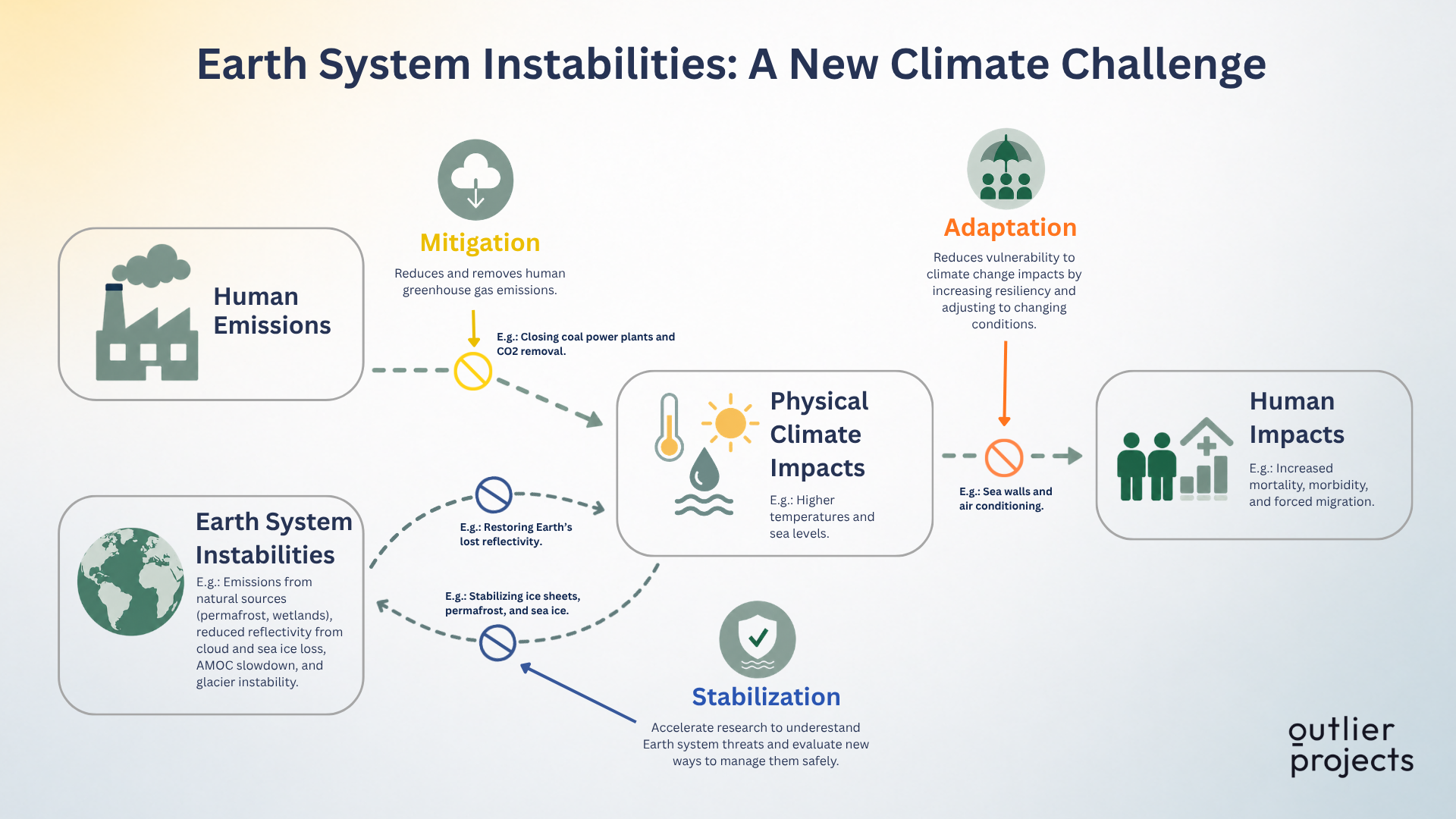
Despite progress on decarbonization, human emissions have set off a chain reaction — from clouds to wetlands, glaciers to ocean currents, critical Earth systems are rapidly destabilizing and taking on their own runaway momentum.
Scientists are warning that we’re dealing with nonlinear risks. Feedback loops and tipping points could trigger sudden and irreversible shifts in planetary systems that in turn could destabilize our political, economic, and social systems.
Earth system instabilities could drive temperatures hotter, raise sea levels higher, and jeopardize the safety of billions of people. The window to stabilize these systems is closing. We urgently need to better understand them and the risks they pose.
Key Earth system instabilities include:
Increasing ecosystem emissions +
Rising temperatures are increasing emissions from ecosystems. Tropical wetland outgassing, thawing permafrost, and forest fires account for a growing share of total emissions. These feedback loops could amplify global warming by 30%.
Declining planetary reflectivity +
Declining cloud cover and sea ice are making the Earth less reflective, causing it to absorb much more solar energy. The increased absorption of solar energy since 2000 is equivalent to all human CO₂ emissions since 1750.
Rising sea levels +
Sea levels are now predicted to rise 2–7 feet by 2100 which would displace hundreds of millions of people. More than 90% of risk and uncertainty is due to instability in the Thwaites Glacier in West Antarctica, which can no longer be stabilized just by lowering emissions or atmospheric temperatures.
Weakening ocean currents +
A massive system of ocean currents called the Atlantic Meridional Overturning Circulation (AMOC) could significantly weaken this century. This would severely disrupt Asian and West African monsoons and shift the global tropical rainbelt southward, causing major droughts in some regions and catastrophic flooding in others.
The Toolbox
These urgent threats require an equally urgent and powerful response. For decades, there have been two main climate change approaches: mitigation of human emissions and adaptation to environmental changes. These efforts remain essential, but we can no longer assume they will be enough.
We need to accelerate research to better understand Earth system instabilities and evaluate whether additional tools could help manage them safely and effectively.
Earth systems stabilization research pathways include:
Predicting Earth system instabilities +
Better predicting the likelihood, timing, and magnitudes of key Earth system instabilities to enable smarter adaptation.
Cutting hard-to-abate methane +
Countering near-term warming by accelerating R&D to address hard-to-abate methane emissions from sources like pasture-based livestock.
Managing ecosystem emissions +
Addressing emissions from permafrost, wetlands, and wildfires by actively managing these ecosystems and enhancing the breakdown of methane in the atmosphere.
Slowing sea ice loss +
Slowing the loss of Arctic sea ice by thinning insulating clouds, allowing more heat to escape into space.
Stabilizing glaciers +
Stabilizing glaciers by pumping out heat or water from underneath to refreeze them to their beds.
Restoring planetary reflectivity +
Restoring some of the reflectivity Earth has lost, potentially by distributing small reflective particles in the stratosphere or brightening marine clouds.
What We Do
Outlier Projects supports skilled teams that coordinate and fund rigorous research to address Earth system instabilities and spur governments to do the same. But this work requires significantly more funding than we alone can provide. That’s why we also convene, educate, and mobilize other philanthropic funders around high-impact funding opportunities.
We accelerate research to understand risks and what we can do about them. We do not advocate for deployment of any specific approach. Some ideas will pan out; others certainly won’t. Our goal isn’t to predetermine what we should or shouldn’t do in the future — it’s to ensure that those future decisions are made on the best possible evidence.
Current Grantees

Contact us.
Have questions about us or our grantees? Send us a message. We’ll get back to you.